Our story
A small company that takes the slow road on purpose
Pon Vayal makes wood-pressed (marachekku) oils, stone-milled flours and plastic-free natural-fibre packaging, sourced directly from farmers in Tamil Nadu, and made without the chemical shortcuts that commodity food has come to rely on.
Our name
The meaning of பொன் வயல்
பொன் வயல், Pon Vayal, is Tamil for “golden field”. It is the picture of ripe grain catching late-afternoon light, of land that has been tended well and gives back honestly. We chose it because it says, in two words, what we care about: food that comes from the earth and stays close to it.
That idea sits behind everything we do and behind the line we put under our name, The Sustainable Company. To us a golden field isn't a marketing image; it is a reminder that good food starts with healthy soil, fair work and as little waste as possible. We try to keep that promise from the seed all the way to the bag it leaves in.
Why we exist
Bringing back the things worth keeping
For a long time the way most of our oils, flours and groceries were made quietly changed. Seed was pressed not in a wooden chekku but with heat and chemical solvents, then refined, bleached and deodorised until little of the original was left. Flour was milled fast and stored long. And almost everything came home wrapped in single-use plastic. None of it was a scandal, it was simply the cheap, convenient default. Pon Vayal exists because we think there is a better, older default worth bringing back.
So we press oil the way it was done for generations: in a traditional marachekku (wooden chekku), slowly and mechanically, with no hexane or other chemical solvents and none of the high-heat refining, bleaching or deodorising that strips a commodity oil of its character. What you get is unrefined oil that still carries its own colour, aroma and flavour, coconut, groundnut and நல்லெண்ணெய் (sesame).
Alongside the oils we mill flours fresh in small batches, so they reach you close to when they were ground rather than after months on a shelf. And we work to replace single-use plastic with reusable natural-fibre bags, woven from banana, cotton and bamboo fibre, for carrying everyday groceries.
Underneath all of it is one simple choice: we buy directly from farmers. That means fresher seed and grain, a clear trail back to the field it came from, and more of the price reaching the people who actually grow it. It is slower and it asks more of us, but it is the part we are least willing to give up.
What we are working towards
Our vision & mission

Our vision
An everyday kitchen where honest, traditionally made food and plastic-free living are the ordinary choice again, not a premium one, and where the farmers who grow our seed and grain earn a fairer, steadier living for doing it well.

Our mission
To press, mill and pack the essentials of a Tamil kitchen with as little processing and as little waste as we can, sourcing directly from farmers, telling the plain truth about how it is made, and replacing single-use plastic wherever we reasonably can.
What we stand on
Four values we don't bend on
These aren't slogans for a wall. They are the rules we use when a decision is hard or an easier shortcut is on offer.
Honesty & transparency
We describe our process, not health miracles. We tell you how an oil is pressed and how grain is milled, and we name the trade-offs, like lower smoke points, instead of hiding them.
Farmers first
Buying directly from farms means fresher produce, a clear trail back to the field, and a fairer price reaching the people who grow it, without a chain of middlemen in between.
Nothing wasted
The oil-cake left after pressing, punnakku, goes on to be protein-rich cattle feed and natural fertiliser, so the whole seed has a purpose rather than a bin.

Plastic-free
Our carry bags are woven from natural fibre, reusable and made to replace single-use plastic, in step with India's move away from thin plastic carry-bags.
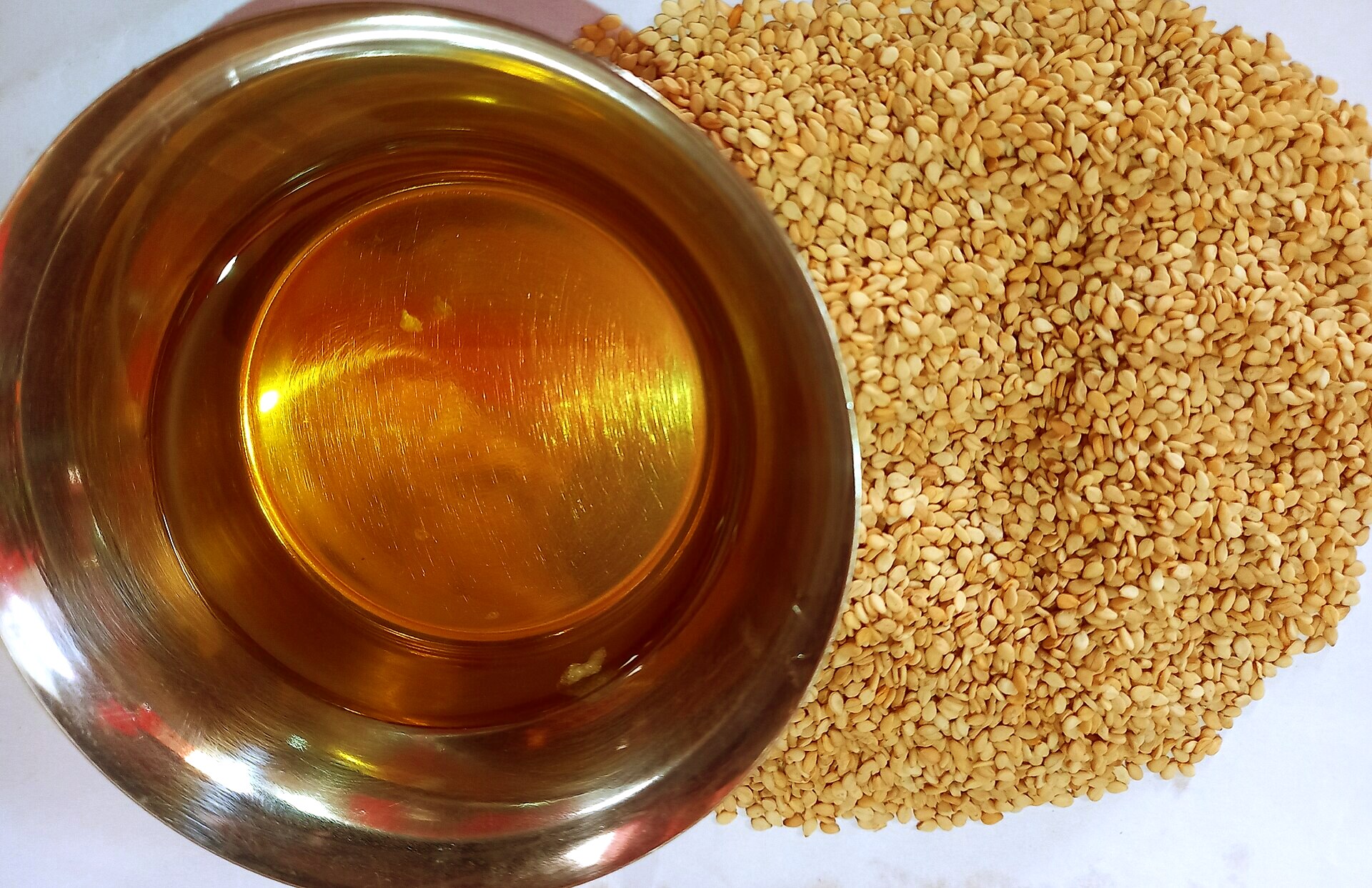 Golden, unrefined oil, just as the seed gives it
The marachekku tradition
An old press, made of vagai wood
“Marachekku” simply means wooden press. The chekku, also called a ghani, is one of the oldest oil-pressing methods in India: a deep mortar and a turning pestle that slowly crush the seed and let the oil run out, historically powered by a bullock walking in a circle.
The press itself is traditionally cut from vagai (Albizia lebbeck), a hard, dense, durable native hardwood. We use it because it is sturdy and long-lasting in this role, nothing more dramatic than that.

Where we are
Rooted in Tamil Nadu, India
Pon Vayal is based in Tamil Nadu, India, close to the farms, the coconut groves and the mills our work depends on. From here we serve customers across India and support bulk and export enquiries for our oils, flours and natural-fibre packaging.
Say hello
Want to know more about how we work?
Ask us anything about our sourcing, pressing or packaging, place an order, or start a wholesale or export enquiry, we're happy to talk it through.
Credits
Photo & artwork credits
We believe in giving proper credit. Several photographs on this site are licensed from Wikimedia Commons under Creative Commons licences, which require attribution. Here is each one, with its author, licence and source.
Photographs (Wikimedia Commons, Creative Commons)
- “A fresh coconut, whole and cracked open” (homepage hero) · “Coconuts - single and cracked open.jpg” · CC BY-SA 4.0 · by Ivar Leidus · source
- “Golden, freshly pressed oil beside sesame seeds” · “Sesame oil photo.jpg” · CC BY-SA 4.0 · by Dr. Satish Upalkar · source
- “Sun-dried copra (dried coconut)”, “Copra full.JPG” · CC BY 2.5 · by Rajesh dangi · source
- “Idli with sambar & chutney”, “Idli-Sambhar-Coconut chutney.jpg” · CC BY-SA 4.0 · by Priyanka Johri · source
- “Woven natural-fibre craft”, “Banana fibre craft.jpg” · CC0 (public domain) · by Rebeccananonof · source
- “A paddy field in Tamil Nadu”, “Paddy field in Tamil Nadu India.jpg” · CC BY-SA 4.0 · by Jperiapandi · source
- “All-purpose flour”, “All-Purpose Flour (4107895947).jpg” · CC BY-SA 2.0 · by Veganbaking.net (USA) · source
- “A groundnut crop in the field”, “Groundnuts farm.jpg” · CC BY-SA 4.0 · by Ibn Dagara · source
- “Sesame (gingelly) in flower”, “Sesamum orientale-1-arur-dharmapuri-India.jpg” · CC BY-SA 4.0 · by Yercaud-elango · source
- “White sesame seeds”, “Sa white sesame seeds.jpg” · CC BY-SA 3.0 · by Sanjay ach · source
- “Groundnut kernels”, “Peanut Kernels.jpg” · CC BY-SA 4.0 · by Thamizhpparithi Maari · source
Original artwork
The Pon Vayal logo, favicon and the full set of illustrated icons (the coconut, groundnut, sesame, oil-bottle, flour, bag, oil-cake, sun, mill and other line drawings used across the site) are original artwork made for Pon Vayal.
A note on the photographs
The remaining stock photographs are placeholders, chosen so the site looks complete while we prepare our own photography. They illustrate the kind of produce, process and craft we work with, they are not pictures of Pon Vayal's own farm or finished products, and we are replacing them with the company's own images.